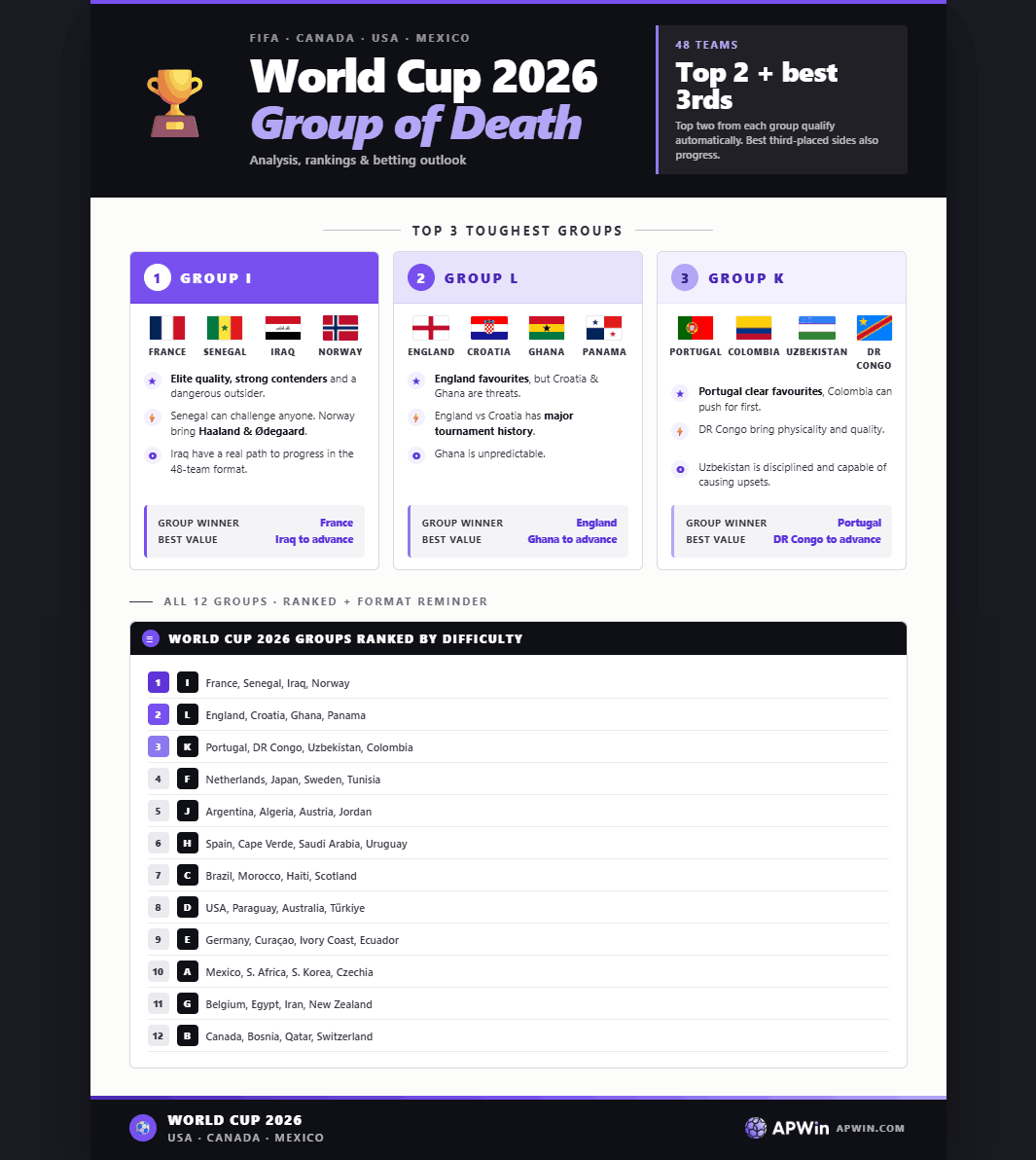
The debate over the World Cup 2026 group of death is already one of the tournament’s biggest talking points, and the data points toward one clear answer: Group I.
France, Senegal, Iraq and Norway form the most difficult section of the expanded 48-team tournament, combining elite title-winning quality, strong continental pedigree, major attacking talent and a dangerous outsider.
In a format where the top two teams from each group advance automatically and the best third-place sides also progress, the traditional idea of a “group of death” has changed. The threat is no longer simply finishing third. It is being forced into a tougher knockout path, losing control of the group early, or relying on third-place calculations.
Why Group I Is the World Cup 2026 Group of Death
France may be the headline team, but the difficulty of Group I comes from what sits beneath them.
Senegal is not a passive second seed. They have the defensive organisation, physical power and transition speed to make the opening match against France a serious test. Their famous 1-0 victory over France at the 2002 World Cup remains one of the most memorable shocks in tournament history, and that result still gives the fixture a strong narrative edge.
Norway add a different problem. In Haaland, they have one of the most ruthless finishers in world football. In Odegaard, they have a creative midfielder capable of controlling tempo and unlocking compact defences. Norway’s return to the World Cup gives the group another layer of uncertainty because their ceiling is far higher than their recent tournament absence suggests.
Iraq are the outsider, but not a harmless one. In a 48-team format, they do not need to dominate the group to survive. A win, or even a draw against the right opponent, could be enough to keep them alive in the race for one of the best third-place spots.
That is what makes Group I so difficult. France is expected to qualify, but the battle beneath them is highly competitive. Senegal and Norway both have credible claims to second place, and Iraq have enough incentive to make every match uncomfortable.
Bet365 Market | Selection | Odds |
|---|---|---|
Group I winner | France | 1.40 |
Group I winner | Norway | 3.75 |
Group I winner | Senegal | 9.00 |
World Cup winner | France | 6.00 |
World Cup winner | Norway | 26.00 |
World Cup winner | Senegal | 101.00 |
Top goalscorer | Haaland | 15.00 |
France vs Senegal | France | 1.45 |
France vs Senegal | Draw | 4.20 |
France vs Senegal | Senegal | 6.00 |
Iraq vs Norway | Iraq | 8.00 |
Iraq vs Norway | Draw | 5.75 |
Iraq vs Norway | Norway | 1.25 |
Group I Betting Outlook
France is the strongest group-winner selection. The price is short, but the logic is clear: they have the deepest squad, the highest floor and the best route to controlling the section over three matches.
The strongest qualification accumulator is France, Norway and Senegal to advance. The expanded format makes it realistic for three teams from a single strong group to progress, and Group I has enough overall quality to support that.
The underdog is Iraq to advance. That bet depends heavily on price, but the format gives Iraq a route. If they can take points from Norway or Senegal, third place may be enough to remain in contention.
How the Group of Death Affects Betting Markets?
Group difficulty matters because betting markets price route risk, not just squad quality. France may still be short to win Group I, but the draw gives them less margin for error and can affect their knockout path.
Norway’s price reflects their upside, yet a group with France and Senegal makes Haaland’s Golden Boot case more dependent on early goals and progression. Senegal is the most interesting dark horse because their outright price is long, but their group price suggests they can still disrupt the section. In a softer group, these numbers would look very different.
Group L: England, Croatia, Ghana and Panama
Group L is the most obvious media-friendly rival for the group of death label. England are expected to top the section, but Croatia and Ghana make the draw far from simple.
England’s meeting with Croatia carries major tournament history. Croatia beat England in the 2018 World Cup semi-final, while England responded with a 1-0 win at Euro 2020. The fixture brings together one of the tournament favourites and one of the most reliable knockout-stage performers of the modern era.
Ghana are the group’s volatility team. They have enough athleticism and attacking talent to challenge Croatia and trouble England, but their consistency remains a question. Panama is the outsider, yet their physical style and tournament experience mean they cannot be dismissed.
England is the best group-winner bet, largely because of squad depth. Croatia are the safest partner in a qualification accumulator, while Ghana are the value underdog to advance. If Ghana beats Panama and takes something from Croatia, their path to the Round of 32 becomes realistic.
Group K: Portugal, Colombia, Uzbekistan and DR Congo
Group K is the hidden contender for the toughest group at the 2026 World Cup.
Portugal is the clear favourite, but Colombia are strong enough to compete for first place. Behind them, DR Congo and Uzbekistan make the section awkward. DR Congo brings physicality and individual quality, while Uzbekistan arrive as a disciplined side with little pressure and a clear opportunity to make history.
Portugal remains the best group-winner pick. They have the technical quality, attacking depth and tournament experience to control the group. Colombia are the natural qualification partner, making Portugal and Colombia the most logical accumulator.
The underdog is DR Congo. In a four-team group with third-place qualification available, they do not necessarily need to beat Portugal or Colombia. One win and a competitive goal difference could be enough to keep them in the tournament.
Ranking the 12 World Cup 2026 Groups by Difficulty
The full difficulty ranking places Group I at the top, followed by Group L and Group K.
Group I: France, Senegal, Iraq, Norway
Group L: England, Croatia, Ghana, Panama
Group K: Portugal, DR Congo, Uzbekistan, Colombia
Group F: Netherlands, Japan, Sweden, Tunisia
Group J: Argentina, Algeria, Austria, Jordan
Group H: Spain, Cape Verde, Saudi Arabia, Uruguay
Group C: Brazil, Morocco, Haiti, Scotland
Group D: USA, Paraguay, Australia, Türkiye
Group E: Germany, Curaçao, Ivory Coast, Ecuador
Group A: Mexico, South Africa, South Korea, Czechia
Group G: Belgium, Egypt, Iran, New Zealand
Group B: Canada, Bosnia and Herzegovina, Qatar, Switzerland
Group of Ease: Group B Looks the Most Winnable
If Group I is the group of death, Group B is the group of ease.
Canada, Bosnia and Herzegovina, Qatar and Switzerland make up the most open section of the tournament. Switzerland are the strongest side on paper, but there is no obvious elite contender. Canada will benefit from familiar conditions and home-continent advantage, Bosnia and Herzegovina has enough quality to challenge for qualification, and Qatar enter as the longshot.
Switzerland are the best group-winner bet. They are experienced, balanced and defensively reliable. The strongest accumulators are Switzerland and Canada to advance, while Bosnia and Herzegovina offer an alternative value route if Canada is priced too short.
Qatar are the longshot angle. In a 32-team format, their task would look far harder. In a 48-team tournament, one strong result could be enough to keep them in the third-place qualification race.
Famous Groups of Death: 2010, 2014 and 2022
The group of death debate has long been part of World Cup culture.
In 2010, Brazil, Portugal, the Ivory Coast and North Korea formed one of the clearest modern examples. Brazil and Portugal advanced, while the Ivory Coast were eliminated despite having one of Africa’s strongest squads.
In 2014, Uruguay, Costa Rica, England and Italy produced one of the most dramatic group-stage shocks in tournament history. Three former world champions were drawn together, but Costa Rica topped the group unbeaten. England and Italy both went out.
In 2022, Spain, Germany, Japan and Costa Rica created another memorable group of death. Japan beat both Germany and Spain to finish first, while Germany was eliminated at the group stage for the second consecutive World Cup.
Those groups show why the label matters. A group of death is not only about the biggest names. It is about jeopardy, imbalance, and the possibility that a strong team will be forced out early.
.webp)